Valadez & Associates Blog
Thought leadership, policy updates & firm news—your go-to source for expert insights.
Arizona's Semiconductor Strategy: From Workforce to International Partnerships
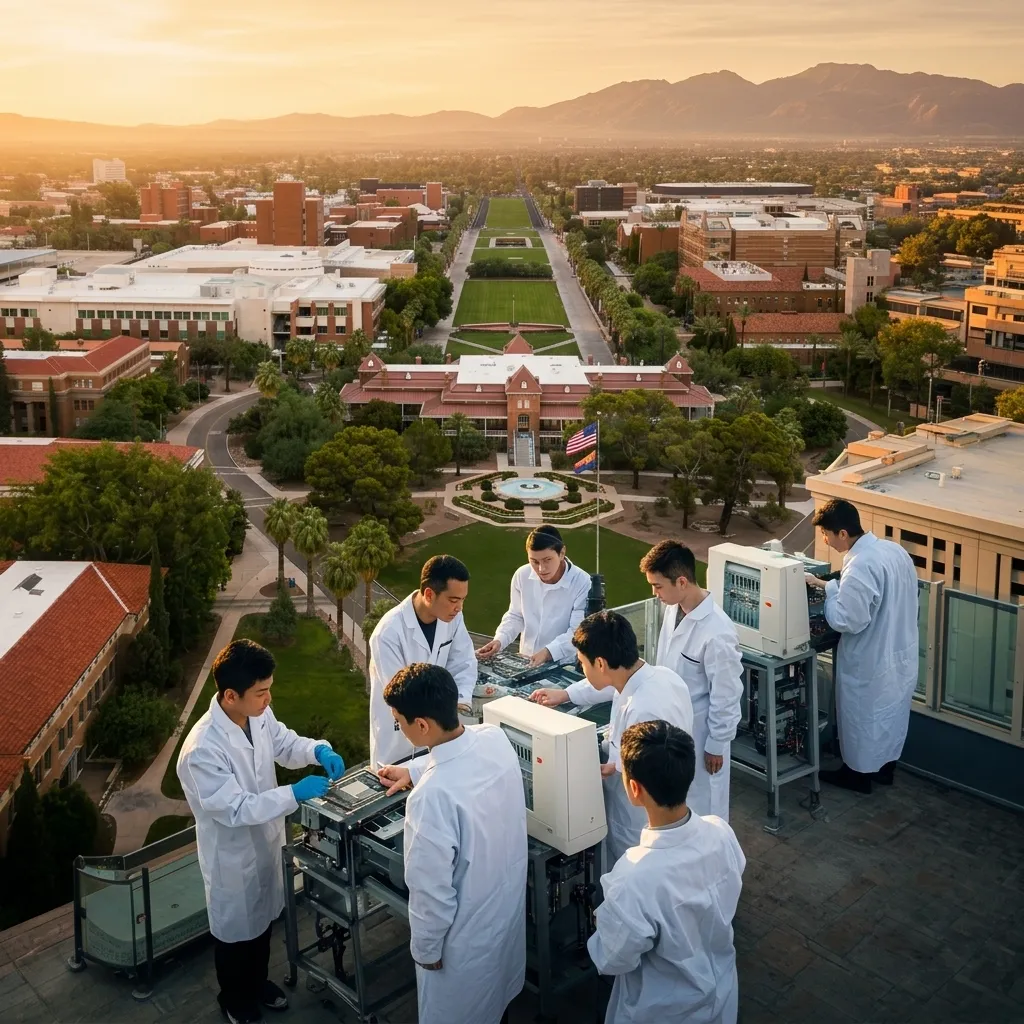
In February 2026, the Arizona Commerce Authority and the University of Arizona announced a $35.5 million expansion of the Center for Semiconductor Manufacturing. While headlines focus on TSMC's Phoenix mega-facility, this investment represents something equally important: Arizona's bet on the workforce that will actually make those facilities operate.
Without this pipeline, even the most generous tax incentives won't attract semiconductor companies. Arizona just ensured it won't face that problem.
The Scale of the Investment
The $35.5 million expansion includes:
New fabrication space— Expanded cleanroom facilities for hands-on student training
Equipment upgrades— State-of-the-art semiconductor manufacturing tools
Curriculum development— Courses aligned with current industry needs
Partnership programs— Direct pipelines to TSMC, Amkor, and other Arizona employers
This isn't theoretical education. This is hands-on training that gives graduates a strong foundation for careers in semiconductor fabrication facilities.
Why Workforce Matters More Than Incentives
This section represents policy analysis, not reported fact.
Here's a reality check: semiconductor fabs require thousands of workers to operate. TSMC's Phoenix facility alone will need thousands of technicians, engineers, and operators. But these aren't jobs that can be filled by generic training — they require specialized skills in semiconductor manufacturing processes.
States can offer the best tax incentives in the world, but if there's no workforce to draw from, those incentives are meaningless. This is exactly why the U of A expansion is such a strategic move:
Incentives attract projects. Workforce sustains them.
Without the U of A pipeline, Arizona would face a critical bottleneck: companies wanting to locate here but unable to find trained workers. The $35.5 million investment is Arizona's insurance policy against exactly that scenario.
Building the International Connection
Arizona's semiconductor strategy extends beyond workforce development to international partnerships that strengthen the entire ecosystem.
Southern Arizona and Southern Taiwan Partnership
Building on record international activity and investment, leaders in Southern Arizona and Southern Taiwan signed a Six-Party Memorandum of Understanding (MOU) on March 13, 2026, to deepen collaboration across the global semiconductor ecosystem while advancing joint research and workforce development in optics, photonics, and advanced manufacturing technologies.
The agreement brings together government, economic development, and academic partners from both regions:
Arizona Commerce Authority
Pima County
City of Tucson
University of Arizona
Kaohsiung City Government (Taiwan)
National Sun Yat-sen University
The partners will collaborate to strengthen semiconductor supply chain resilience, expand workforce development initiatives, and deepen research partnerships between Southern Taiwan and Southern Arizona — two regions that play increasingly important roles in the global semiconductor and advanced technology ecosystem.
Three Pillars of Collaboration
The memorandum focuses on three core areas:
Industrial Resilience: Partners will promote public-private collaboration to enhance the resilience and sustainability of the semiconductor supply chain, including sharing best practices related to industrial policy, innovation, natural resource stewardship, and ecosystem development.
Talent Development: The agreement creates new opportunities for academic exchanges, joint research initiatives, and workforce development partnerships between the University of Arizona and National Sun Yat-sen University, supporting the next generation of engineers and researchers across semiconductor, optics, and advanced manufacturing fields.
Governance and Institutional Exchange: Participating organizations will encourage exchanges among government leaders, universities, and institutional stakeholders to share expertise in infrastructure planning, innovation policy, and industry-supportive development strategies.
Optics Valley: Southern Arizona's Global Strength
Southern Arizona is internationally recognized for its leadership in optics and photonics, anchored by the University of Arizona's world-renowned College of Optical Sciences, College of Engineering, and College of Science and a dynamic cluster of companies and research institutions in Tucson often referred to as "Optics Valley." These capabilities support critical semiconductor technologies, including advanced sensors, precision manufacturing, imaging systems, and next-generation optical components.
The partnership connects this globally recognized optics and photonics ecosystem with Southern Taiwan's semiconductor manufacturing leadership, creating new opportunities for research collaboration, workforce development, and technology commercialization across both regions.
A Growing Trade Relationship
This collaboration reflects the growing strategic ties between Arizona and Taiwan in the semiconductor industry. Both regions are home to key elements of the global semiconductor supply chain, including major manufacturing investments by Taiwan Semiconductor Manufacturing Company (TSMC) in Arizona and its longstanding operations in Taiwan.
In 2025, Taiwan became Arizona's second-largest trading partner with more than $21.2 billion in total trade, with exports to Taiwan reaching $4.5 billion and $16.7 billion worth of goods imported from Taiwan.
The Business Opportunity
For companies looking to locate in Arizona, the workforce pipeline is taking shape — but there's still work to do. The companies who will benefit most from this expansion are those who engage early:
Semiconductor Equipment Suppliers: Companies providing manufacturing equipment need workers trained on their specific systems. Early partnership with U of A creates preferred access to graduates.
Advanced Packaging: Amkor Technology is building advanced packaging facilities in Arizona. They need technicians now — and the U of A pipeline provides exactly that.
Data Center Operators: Yes, data centers. The high-tech workforce training applies to anyone needing technicians with semiconductor-adjacent skills.
Economic Development Consultants: For site selection firms, this changes the conversation. Arizona no longer just offers incentives — it offers a complete ecosystem.
The Competitive Reality
Arizona isn't alone in this investment. Other states are also building semiconductor workforce pipelines:
Texas— Community college programs focused on semiconductor manufacturing
Ohio— $100 million workforce initiative
New York— Partnership with IBM on training programs
Note: Competitive comparisons are analytical, not sourced from official state data.
Questions for Business Leaders
How do I partner with U of A's program? Contact the Center for Semiconductor Manufacturing directly — early engagement provides curriculum influence and hiring advantages.
What's the timeline for graduates? The expanded-program graduates are expected as the program scales — companies needing workers sooner should explore internships and co-op programs.
How does this compare to community college alternatives? U of A focuses on engineering-level positions; community colleges handle technician-level training. Both are essential parts of the ecosystem.
How can my company leverage the international partnerships? The MOU between Southern Arizona and Southern Taiwan creates new opportunities for research collaboration, talent exchange, and supply chain integration.
The Bottom Line
The $35.5 million U of A investment is about more than just training workers. It's about ensuring Arizona can actually deliver on the promise of its semiconductor boom.
For business leaders evaluating Arizona, this investment should reinforce a simple point: Arizona is building a comprehensive ecosystem, not just offering tax incentives. The workforce infrastructure is being put in place because the state understands that talent — not just tax breaks — will determine which regions succeed in the semiconductor industry.
If you're considering expansion in Arizona, the question is no longer "can we find workers?" The question is "how fast can we lock in our spot in the pipeline?"

Mailing Address:
PO Box 31
Sahuarita, AZ 85629
Prefer to speak directly? Call(602) 804-0053
Phoenix Office Address:
2801 E Camelback Rd, Suite 200
Phoenix, AZ 85016



© Copyright 2025. Valadez & Associates LLC.
All Rights Reserved.