Valadez & Associates Blog
Thought leadership, policy updates & firm news—your go-to source for expert insights.
Arizona's $200 Billion Question: Can the Workforce Keep Up?
Introduction
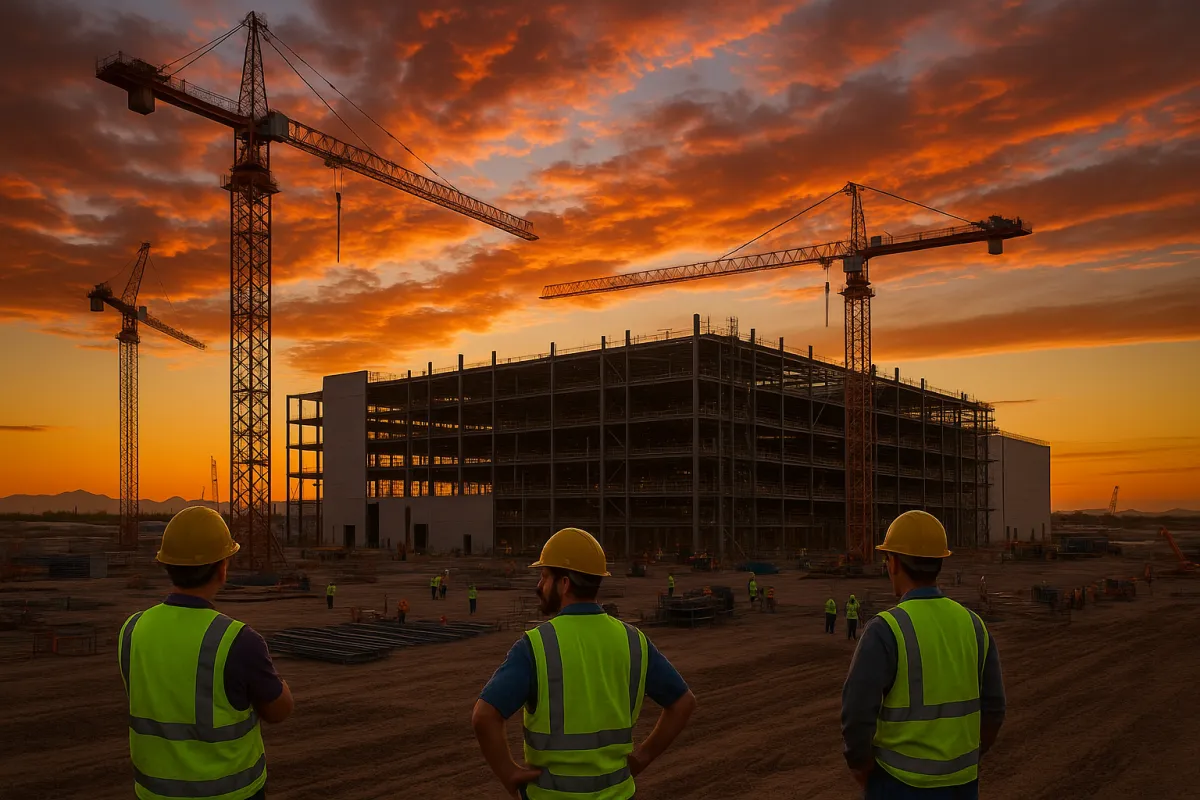
Arizona has become one of the most active construction markets in the country. By early 2025, Industrial Info Resources tracked nearly$50 billion in active industrial construction across the state. Semiconductor fabs, data centers, power plants, and mining operations lead the pipeline. The announced investment totals approximately$205 billion through the end of the decade.
But here's the problem: the money is committed. The workforce isn't.
The Scale of the Opportunity
The drivers behind Arizona's growth are structural, not cyclical:
CHIPS and Science Act: $11.6 billion in loans and grants to TSMC alone
Inflation Reduction Act: Continuing to incentivize clean energy and advanced manufacturing
Arizona's advantages: Business-friendly climate, abundant land, available power capacity
Current pipeline: Over 60 semiconductor expansions representing $205 billion in announced investment
At SEMICON West in Phoenix, more than600 ecosystem partners from 17 countries gathered to discuss the clustering effect reshaping Greater Phoenix. The momentum is undeniable.
The Leadership Shortage
TSMC, Intel, hyperscale data centers, and major infrastructure programs are all competing for the same experienced superintendents and project managers. According to The Birmingham Group, a construction executive search firm:
"Firms that secure proven leaders early are winning the best work."
Every major project needs:
Construction superintendents
Project managers
Project executives
Field leaders with multi-year experience
The math doesn't work: With $50 billion in active projects and a limited pool of experienced construction leaders, companies are bidding against each other for the same talent.
What Most People Are Missing
It's not just about semiconductor jobs— Every chip-manufacturing job supports four to five additional jobs in the economy (Semiconductor Industry Association). The multiplier effect creates demand across trades, logistics, services, and support industries.
The pipeline visibility— Projects extend through 2026 and beyond, creating multi-year career runways. This makes relocation decisions easier to justify for experienced professionals.
Competition for leadership— GCs, developers, and construction firms are all competing for the same 10+ year veterans. The shortage isn't at the entry level—it's at the management level.
Arizona's timing advantage— Unlike other emerging markets, Arizona has visible, funded projects now. Professionals aren't guessing whether the work will materialize—they can see it.
How to Implement
Recruit aggressively— Companies with established recruiting pipelines are winning. If you're not actively recruiting from other markets, you're losing talent to Arizona competitors.
Invest in upskilling— GCU's partnership with TSMC offers 12-18 months on-the-job training. Internal development programs are essential for building the next generation of leaders.
Partner with educational institutions— Community colleges and universities are expanding semiconductor training pipelines. Early partnerships provide access to emerging talent.
Create retention strategies— With multiple employers competing for the same talent, compensation alone isn't enough. Career development, culture, and project variety matter.
Broader Impact
This isn't just a construction industry problem. Every sector adjacent to Arizona's mega-project boom—logistics, manufacturing, professional services, healthcare—is affected by the same workforce constraints.
The companies that understand this dynamic will have a strategic advantage. Those that assume "they'll figure it out" will find themselves short-staffed for years.
Closing Takeaway
Arizona's $200 billion construction pipeline represents a generational opportunity—for companies, for workers, and for the state's economy. But the bottleneck isn't capital. It's leadership.
The firms and communities that solve the workforce challenge first will capture the most value. The rest will be left bidding for scraps.
References
The Birmingham Group, "Arizona Mega Projects 2026: $200B Semiconductor, Infrastructure and Industrial Construction Pipeline," March 2026
👉https://thebirmgroup.com/arizona-mega-projects-2026/Semiconductor Industry Association, 2023 Report on job multipliers
👉https://www.semiconductors.orgKTAR.com, "GCU, TSMC team up on semiconductor career training," March 2026
👉https://ktar.com/arizona-education/semiconductor-gcu-tsmc/5829901/

Mailing Address:
PO Box 31
Sahuarita, AZ 85629
Phoenix Office Address:
2801 E Camelback Rd, Suite 200
Phoenix, AZ 85016



© Copyright 2025. Valadez & Associates LLC.
All Rights Reserved.